Danny
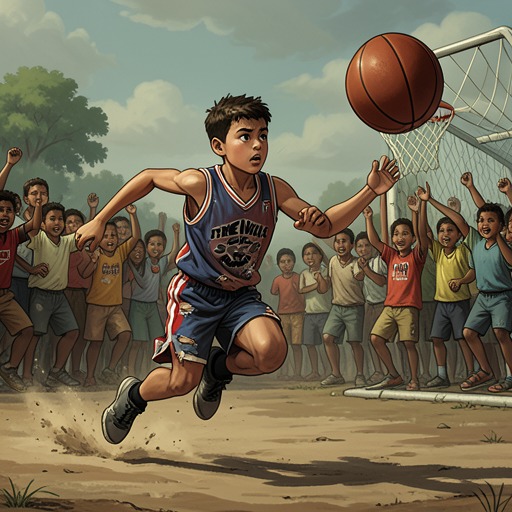
Kevin the Star StrikerDanny is the Wild Soccer Bunch’s best friend of Kevin and its exceptionally fast attacking player, described at different moments as the world’s fastest right forward and the world’s fastest midfielder. His decisive significance lies in the way he converts friendship and speed into collective movement: he is not merely a runner who breaks away from opponents, but a dependable link in the passing game that allows the team to attack as one.
Identity and Role
Danny is introduced through Kevin’s intimate team portrait. Kevin says that Danny is his best friend, that he relies on him completely, and that he hopes Danny will never stop playing soccer. The description establishes both Danny’s athletic distinction and his emotional importance: he is the player Kevin trusts most closely, and his value is measured as much through that trust as through his pace.
Danny’s identity is not limited to soccer. Kevin notes that Danny is interested in many other things, including girls, distinguishing him from the younger Tyler. This detail gives Danny a small but definite life beyond the field. He is presented as a boy entering a wider social world while remaining deeply committed to the game and to the Wild Soccer Bunch.
Life Around the Team
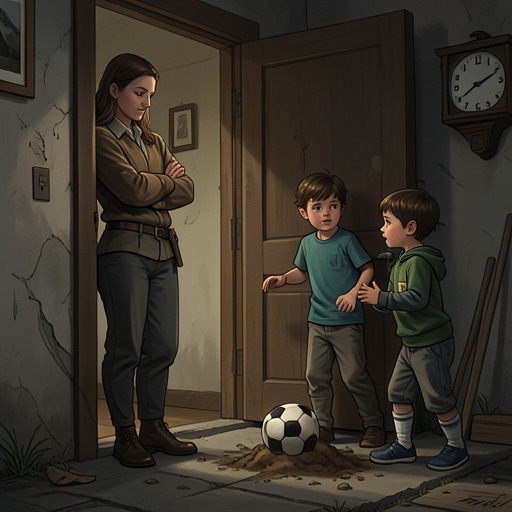
Danny’s soccer life is woven into the neighborhood’s improvised playing spaces. During the winter indoor games, he charges through the room at 44 Dearborn Street as though it were a sideline, while Julian Fort Knox waits in the house across the street. The imaginary transformation of bedrooms and living rooms into Toyota Park shows Danny’s speed operating inside the team’s shared make-believe, where ordinary domestic spaces become a real competitive arena.
His intensity can also outrun his control. After the Wild Soccer Bunch defeats winter and seemingly saves spring break, Danny advances too quickly to stop and crashes into a bookshelf. Books and boxes fall over him, and Dearborn Street seems to shake. The incident turns his greatest quality into a physical hazard: speed brings exhilaration and attacking power, but it also demands judgment and restraint.
Danny’s loyalty is visible even when communication fails. When he calls Alex, hears silence, and recognizes the breathing on the other end of the phone, he becomes impatient and tells Alex that he expected him to be on the soccer field. Alex remains silent while his mother cleans the house on Woodlawn Avenue, leaving Danny to hear only the vacuum. Danny’s reaction reveals his expectation that teammates should be present and involved; the game is not an occasional pastime to him but the natural center of the group’s life.
Actions in the Decisive Match
In the match against the Unbeatables, Danny participates in the team’s first major attacking sequence. After the battle cry “ONE, TWO, THREE WILD!” the ball moves from Kevin to Alex, back to Tyler, then toward Danny running up the sideline. Danny receives and returns the ball into the coordinated sequence, helping create the opening that eventually reaches Joey and then Kevin. The play matters because Danny’s speed is made meaningful by passing: he accelerates the attack without isolating himself from the team.
Later, when the score has reached seven to four, Danny scores his second goal as the Wild Soccer Bunch begins its extraordinary comeback. The team has practiced for twelve days on muddy ground, and the rain turns the field soft while the Unbeatables slide across it. Danny’s pace and movement become especially valuable under these conditions, as the Wild Soccer Bunch dances through opponents who can no longer control the surface. His second goal forms part of the sequence that carries the team from a crushing deficit to a seven-seven tie and then into the lead.
Danny continues to function as an attacking outlet when the match reaches its most complicated stage. Tyler drives through the middle and passes to Danny on the right; Danny then sends the ball across the field toward the penalty spot. Kevin gathers it in the air, passes backward under pressure, and Alex eventually strikes toward the goal. Danny’s contribution is therefore not reducible to a goal statistic. He provides width, timing, and the connecting pass that keeps the attack alive when the Unbeatables’ defenders close around the ball.
Relationships and Team Values
Kevin’s relationship with Danny is defined by reliance rather than rivalry. Kevin calls him his best friend and expresses hope that Danny will continue playing, making Danny a figure of continuity within the Wild Soccer Bunch. Their connection also fits the team’s broader principle that individual ability becomes effective only when players trust one another and keep the ball moving.
Danny’s conduct in the final match contrasts with the Unbeatables’ model of domination. Mickey the Bulldozer boasts after scoring five goals in seven minutes, while the Wild Soccer Bunch is initially reduced to injuries, fear, and silence. Larry’s insistence that fear can become strength reframes courage as something collective rather than purely aggressive. Danny’s role in the comeback supports that alternative: his speed serves passing, cooperation, and recovery instead of solitary power.
The team’s masculine language is deliberately unsettled by this contrast. Mickey represents intimidation, physical bulk, and contempt, whereas Danny’s athletic authority is expressed through movement within a group. The evidence does not show Danny making a speech about fear or leadership, but his repeated willingness to run into the team’s combinations gives concrete form to a less domineering kind of strength.
Change and Narrative Function
Danny does not receive a solitary transformation as dramatic as Roger’s emergence as the match winner, but his function changes in the reader’s understanding. At first he is Kevin’s extraordinarily fast best friend, a recognizable attacking specialist. In the decisive match, he becomes part of the mechanism of the comeback, proving that the team’s victory depends on a chain of contributions rather than on one hero acting alone.
His recurring presence also helps organize the match’s sports-reporting rhythm. He appears on the sideline, receives and returns passes, scores his second goal during the muddy seven-seven surge, and again supplies the ball from the right as the attack develops. When Roger finally scores the winning goal and the team carries him across the field, Danny remains one of the players whose speed and passing made that victory possible. The ending therefore preserves Danny’s central identity: he is the fast-moving friend whose greatest achievement is not separation from the team, but making the team’s collective attack possible.